Why Your Lashes Shed More in Autumn - and What Is Actually Normal
Quick Answer: Eyelashes have their own growth cycle of roughly one to two months of growing followed by a resting phase, and losing one to five a day is normal. Seasonal increases in shedding are commonly reported in autumn, likely alongside the same seasonal hair shedding pattern. Extensions, lash curlers, sleeping in mascara, and eye rubbing all add mechanical loss on top. Full regrowth takes six to eight weeks.
The reason it feels sudden is that lashes shed in loose synchrony, so a batch reaching the end of the cycle together is very noticeable.

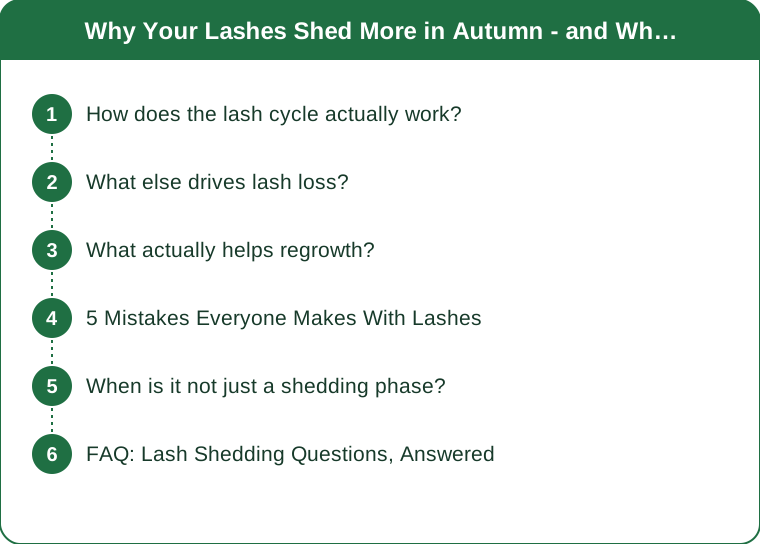
How does the lash cycle actually work?
Three phases, and it is much shorter than scalp hair.
Growth phase: roughly one to two months, considerably shorter than the years-long growth phase of scalp hair. This is why lashes have a fixed maximum length and scalp hair does not.
Transition and resting phase: the follicle stops producing and the lash sits in place, still attached but no longer growing. This can last several weeks.
Shedding: the lash falls out and a new one begins.
Total cycle: commonly cited at around three to five months.
Normal daily loss is one to five lashes. With something like 90-150 lashes on an upper lid and fewer on the lower, that is a steady turnover you would not usually notice.
Why it becomes noticeable in autumn. Lashes are not perfectly out of sync with each other. Anything that affects the follicles collectively - a stressful period, an illness, a seasonal change - can push a group into the resting phase at a similar time, and they then shed together several weeks later. The delay between the trigger and the shedding is the reason people cannot identify a cause - the thing that caused it was two or three months ago.
The scalp hair connection: seasonal shedding of scalp hair around late summer and autumn is widely reported and has some supporting evidence. Lashes are hair, on a shorter cycle, and it would be surprising if they were entirely exempt.
What else drives lash loss?
Mostly mechanical, and mostly avoidable. This is where the actionable part is.
Lash extensions. The most common cause of significant lash loss in people who have them. The mechanism is weight and tension - an extension heavier or longer than the natural lash pulls on the follicle over weeks. Poor application, extensions applied to multiple natural lashes at once, and picking at them all make it substantially worse. Traction damage from extensions can take months to recover, and repeated cycles without breaks can affect regrowth.
Lash curlers. Safe when used correctly and a reliable cause of breakage when not. The two errors are curling after mascara, which glues lashes to the pad and pulls them out, and using a curler with a worn or hardened rubber pad. Replace the pad every three months.
Sleeping in mascara. Dries the lash, makes it brittle, and increases breakage. Also a genuine risk for eye irritation and infection.
Rubbing your eyes. The most underestimated cause. Allergy season, tiredness, and contact lenses all increase it, and autumn allergies specifically overlap with the seasonal shedding window - which is likely part of why the effect feels so pronounced in this period.
Waterproof mascara removal. The removal is more damaging than the product. Waterproof formulas require rubbing unless you soak them off, and rubbing is the problem. Hold a soaked pad against closed lashes for 20-30 seconds before wiping, and use a bi-phase remover.
Harsh cleansing. Aggressive face washing over the eye area, particularly with a cloth or a brush, contributes more than people realise.
What actually helps regrowth?
Time is the main ingredient. A few things genuinely support it, and several popular options do not.
Give it six to eight weeks minimum, and up to three months for a full cycle. Any product claiming faster than that is describing the natural cycle rather than accelerating it.
What has support:
- Prescription bimatoprost, the only treatment approved specifically for inadequate lashes. It works and it has documented side effects including eyelid darkening, irritation, and in rare cases permanent changes in iris colour with certain uses. It requires a prescription and a conversation with a doctor
- Over-the-counter peptide serums, where the evidence is mixed and considerably weaker. Some contain prostaglandin analogues without prescription oversight, which is worth knowing before you buy something from an unregulated source
- Stopping the mechanical damage, which is by far the most effective intervention available to most people and costs nothing
What has little support:
- Castor oil. Popular, widely recommended, and not supported by meaningful evidence for lash growth. It is a heavy oil that can cause irritation or styes in some people, and getting oil in the eye overnight is a common complaint
- Vaseline, same reasoning
- Most vitamin-based lash products
What supports hair generally, including lashes: adequate protein, iron sufficiency, and treating any underlying deficiency. Iron deficiency in particular is a well-established contributor to hair shedding and is common enough - particularly in menstruating women - to be worth checking if the shedding is significant or persistent.
A practical break for extension wearers: several weeks off between sets, and a shorter, lighter set when you go back. Most reputable technicians will recommend this themselves.

5 Mistakes Everyone Makes With Lashes
1. Curling after mascara. Guarantees lashes stick to the pad and come out. Curl first, always, on clean dry lashes.
2. Never replacing the curler pad. A hardened pad has a sharp edge that cuts rather than curls. Every three months, and they cost very little.
3. Rubbing to remove waterproof mascara. Soak for 20-30 seconds with a bi-phase remover held against closed lids, then wipe gently downward. The rubbing is what causes the loss, not the mascara.
4. Going straight into another set of extensions. Back-to-back sets with no break is the pattern most associated with lasting thinning. Take several weeks between sets, and go lighter than the technician offers.
5. Panicking at week two. The third mistake surprises people, but this one causes the most unnecessary spending. A shedding phase looks alarming and regrowth is invisible for the first few weeks because new lashes are short and pale. Take a photo, wait six weeks, and compare - almost everyone concludes it recovered on its own, after buying three products they credit with the recovery.
When is it not just a shedding phase?
Five signs that warrant a proper look rather than waiting it out.
Loss in patches rather than evenly. Even thinning across the lash line is consistent with a cycle. A distinct bald section is not, and can indicate alopecia areata affecting the lashes or another localised cause.
Loss of eyebrow hair at the same time. Simultaneous brow and lash loss is a recognised pattern with thyroid dysfunction, particularly the outer third of the brow. Thyroid problems are common, easily tested, and frequently missed.
Redness, crusting, or persistent irritation at the lash line. Blepharitis - inflammation of the eyelid margin - is common, causes lash loss, and is very treatable. It often presents with morning crusting and a gritty feeling.
Shedding that continues past three months without any sign of regrowth. A cycle resolves. Something ongoing does not.
Loss accompanied by wider hair shedding, fatigue, or other symptoms. This is the combination that most often points to something systemic - iron deficiency, thyroid, or a period of significant physiological stress. Blood work is straightforward and worth asking for.
What a doctor or optometrist will look for: eyelid inflammation, signs of a skin condition affecting the lid, evidence of traction damage, and any systemic cause. Most causes of lash loss are benign and treatable, and the ones that are not benefit substantially from early attention.
This is general information, not medical advice. Persistent lash loss, patchy loss, or loss with eyelid inflammation is worth having assessed rather than treating with a serum.
FAQ: Lash Shedding Questions, Answered
How many lashes a day is normal to lose?
One to five. More than that consistently, or noticeable thinning, is worth paying attention to.
How long do lashes take to grow back?
Six to eight weeks for meaningful regrowth, and up to three months for a full cycle. There is no reliable way to speed this up other than prescription treatment.
Does castor oil work?
There is no meaningful evidence that it grows lashes. It can cause irritation or styes in some people, and oil migrating into the eye overnight is a frequent complaint.
Are extensions permanently damaging?
Not usually, when applied well and with breaks between sets. Repeated heavy sets with no recovery is the pattern most associated with lasting thinning.
Should I stop wearing mascara while they regrow?
Not necessary. Stopping waterproof formulas and improving the removal technique matters far more than stopping mascara altogether.
TL;DR:
- Lashes cycle every three to five months, and losing one to five a day is normal
- Autumn shedding is commonly reported and lags its trigger by weeks, which is why it seems causeless
- Extensions, curlers used after mascara, eye rubbing, and waterproof removal are the avoidable causes
- Regrowth takes six to eight weeks; castor oil has no real evidence behind it
- Patchy loss, brow loss, lid inflammation, or loss past three months should be checked
Take a photo, stop the mechanical damage, and wait six weeks before buying anything. Most of the time that is the whole treatment.
Keep Reading
This article is for general informational and styling purposes only. Fit, sizing, and product availability may vary.