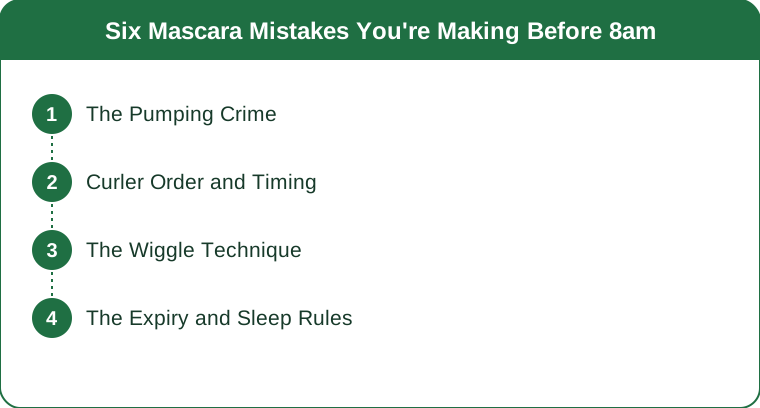
Six Mascara Mistakes You're Making Before 8am
Quick Answer: The most common mascara mistakes are pumping the wand (which dries out the formula), curling after applying instead of before, sweeping straight up instead of wiggling at the root, keeping a tube past three months, and sleeping in it overnight. Each fix takes about ten seconds and adds up to noticeably healthier, better-coated lashes.
Mascara is the one makeup step almost everyone does every single morning, and almost nobody was ever formally taught. Six small habits, repeated a few hundred mornings a year, quietly cost you lashes and leave you clumping product you didn’t need to waste. Let’s audit the routine.

Why does pumping the mascara wand ruin your formula?
Pumping the wand in and out of the tube shoves air straight into the formula, which is mascara’s fastest route to flaky, clumpy, and prematurely dried out. Every pump pushes air in and pulls product toward the tube’s opening, where it dries against the cap threads.
The fix is a simple swap in motion: swirl the wand instead, the way you’d stir a small pot of paint rather than plunge a piston. It sounds like a minor difference, but it changes how much air gets trapped in the tube, which directly affects how long the formula stays smooth and workable.
Should you curl your lashes before or after applying mascara?
Always curl before mascara, never after. Curling lashes that are already coated in product is one of the more common ways lashes actually snap off, since dried mascara makes the hair shaft brittle and far less flexible against the curler’s pressure.
The technique that gets the best lift: about ten seconds at the base of the lash line, a few gentle pulses rather than one hard clamp, then move to mascara once the curl is set. That eye-opening lift is the entire reason eyelash curlers exist as a separate step in the first place — skipping the order defeats the purpose.
What’s the wiggle technique and why does it matter?
A straight upward sweep of the wand mostly coats the tips of your lashes and skips the roots almost entirely. Wiggling the wand side to side at the base first, then drawing it up through the length, gets product distributed along the whole lash instead of just the ends.
The roots are doing most of the volume work, which is why this small change in motion makes a bigger visible difference than adding another coat. One coat applied with the wiggle technique tends to look fuller than three coats swept straight up — it’s a technique problem more often than a product problem.
How often should you replace mascara, and is sleeping in it really that bad?
Replace a tube roughly every three months, regardless of how much product is left. Mascara is applied close to the eye and re-dipped repeatedly, which makes it one of the more bacteria-prone products in a makeup bag — the expiration guidance exists for a real reason, not just to sell more tubes.
Sleeping in mascara is its own separate problem. Left on overnight, it dries out further and becomes brittle, and brittle mascara pulls at the lash shaft when it eventually comes off — during a shower, a pillow rub, or your own hands rubbing your eyes at 2am. Removing it before bed is really just lash retirement planning: a few seconds nightly versus the risk of losing lashes to something entirely avoidable.
If your lashes are shedding heavily, breaking near the base, or an eye feels persistently irritated after switching products, it’s worth checking in with a dermatologist or eye doctor rather than assuming it’s just a technique issue — most mascara problems are fixable habits, but not all of them are.
What Nobody Tells You About Mascara
Nobody tells you that the “waterproof mascara for everyday wear” habit is quietly working against you — waterproof formulas need harder rubbing to remove, and that extra friction is rougher on the lash line over time than a regular formula taken off with a gentle remover. Save waterproof for actual waterproof occasions.
Nobody tells you that a dry, clumpy mascara can sometimes be revived, briefly, with a few drops of clean saline solution rather than water — though this is a stopgap, not a long-term habit, and it’s still best to replace the tube on schedule rather than lean on the trick.
And nobody tells you that lash serums, clean mascara removal, and even just eating a reasonably balanced diet all play a bigger role in how your natural lashes hold up over the months than the mascara brand itself. The wand technique matters, but it’s one piece of a bigger picture.
FAQ: Mascara Mistakes
Why does my mascara get clumpy so fast?
Pumping the wand in and out of the tube is the most common cause — it pushes air into the formula and dries it out faster than normal use would. Swirling the wand instead of pumping, and swapping the tube every three months, both help prevent clumping.
Is it bad to curl your lashes after you’ve already applied mascara?
Yes — curling over dried mascara makes lashes more likely to snap since the coating stiffens the hair shaft. Curl first, while lashes are still bare and flexible, then apply mascara afterward.
How long can you actually keep a tube of mascara?
Around three months is the standard guidance, even if there’s visibly product left in the tube. Mascara is repeatedly re-dipped near the eye, which makes it more prone to bacterial buildup than most other makeup products.
TL;DR:
- Swirl the wand instead of pumping it to keep air out of the formula and prevent clumping.
- Always curl lashes before mascara, never after — curling coated lashes causes breakage.
- Wiggle the wand at the root before sweeping up for fuller-looking coverage.
- Replace mascara every three months regardless of how much product is left.
- Never sleep in mascara — remove it nightly to prevent brittle, breakage-prone lashes.
Keep Reading
This article is for general informational and styling purposes only. Fit, sizing, and product availability may vary.