Why Your Brows Look Uneven in Photos But Fine in the Mirror
Quick Answer: A mirror shows you a reversed image you have seen your whole life, so your brain treats that version as correct. A photo shows the unreversed version, and every natural asymmetry you had learned to ignore now appears on the wrong side and reads as new. On top of that, cameras flatten depth and add directional shadow, both of which exaggerate differences in brow height and arch. Your brows are almost certainly the same as they were. The image changed, not the face.
It is a genuinely disorienting moment. You did your brows, checked twice, and the photo comes back with one clearly sitting higher than the other. Nothing moved between the mirror and the camera.

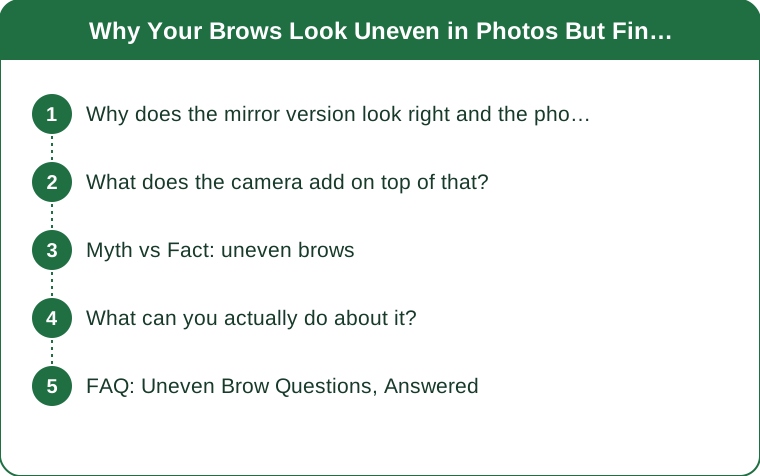
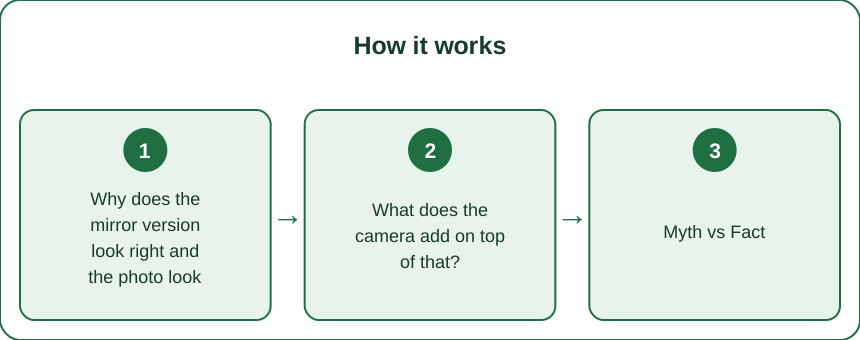
Why does the mirror version look right and the photo look wrong?
Two effects stack here.
The mere-exposure effect. We prefer things we have seen more often. You have seen your mirror face tens of thousands of times and your photographed face far less. Research on this is fairly consistent: people tend to prefer their mirror image of themselves, while their friends prefer the photograph - because the friends have only ever seen the unreversed version.
Learned asymmetry correction. Nearly every face is asymmetric. One brow sits slightly higher, one eye is a fraction more open, one side of the mouth lifts more. In the mirror, you have been looking at that asymmetry, in that orientation, forever - so your brain has normalized it. Flip it, and the same asymmetry appears in an unfamiliar arrangement. Your brain flags it as wrong even though it is identical.
This is why the effect is strongest in photos of yourself and essentially absent when you look at photos of other people. You have no reversed baseline for them.
What does the camera add on top of that?
Several things, and unlike the psychology, these are fixable.
Flattening. A lens compresses three dimensions into two, so a brow that sits slightly forward on a brow bone loses that depth cue and reads purely as height difference.
Directional light. Overhead or side lighting casts a shadow under one brow and not the other. Brow shape is largely read through shadow, so uneven light produces genuinely uneven-looking brows in the image. A window at 45 degrees to your face is the most common culprit and the easiest fix - turn to face it.
Head tilt. Almost everyone tilts slightly, usually the same direction every time. A two-degree tilt is invisible to you and clearly visible in a photo, and it changes the apparent height relationship between the two brows more than any grooming difference would.
Lens distortion at close range. Selfies taken at arm’s length enlarge whatever is nearest the lens and skew the geometry of the upper face. Step back and zoom in slightly, or use the rear camera - the difference in apparent symmetry is often larger than anything makeup could achieve.
Expression. Most people raise one brow slightly when concentrating or being photographed, and it is nearly always the same one.

Myth vs Fact: uneven brows
Myth: Perfectly symmetrical brows are achievable with enough precision.
Fact: They are not, because the underlying bone and muscle are not symmetric. The widely repeated guidance in the industry is that brows are sisters, not twins - and matching them exactly usually looks stranger than the original difference, because it fights the face underneath.
Myth: If one brow is higher, you should draw the other one up to match.
Fact: Lifting the lower one usually creates a surprised, tense look on that side. Working on the tail - extending or lowering the outer third - shifts perceived height with far less distortion.
Myth: The mirror is the accurate one.
Fact: Neither is accurate to what people see. The mirror is reversed; the photo has lens and lighting artifacts. The truest reference is a photo taken from a few feet away at eye level in even, front-facing light.
Myth: Uneven brows mean uneven grooming.
Fact: Muscle tone differences between the two sides of the face are extremely common - one frontalis muscle is often slightly more active. That is a movement difference, not a hair difference, and no amount of shaping addresses it.
Myth: You should shape both brows in the mirror at the same time.
Fact: Shaping while looking straight into a mirror means you are checking a reversed image with your own head tilt built in. Photographing your face straight on and checking that image is a much more reliable reference point.
What can you actually do about it?
Split the fixes into image fixes and grooming fixes, and do the image ones first because they are free.
Image fixes:
- Face your light source directly. Even, frontal light removes most apparent asymmetry instantly.
- Level your head. Ask someone or check on a video preview. Correcting a habitual tilt does more than makeup.
- Move the camera back and zoom, rather than shooting at arm’s length.
- Camera at eye level, not below - shooting up exaggerates the upper face.
Grooming fixes:
- Map the two brows from your own landmarks, not from each other. Inner edge above the inner corner of the eye, arch peak roughly above the outer edge of the iris, tail ending on a line from the nose past the outer eye corner.
- Adjust the tail before anything else. The tail carries most of the perceived height and it is the most forgiving area to change.
- Match the underside line, not the top. The lower edge is what the eye actually reads as brow position; the top is fuzzier and less noticed.
- Fill in short strokes with a fine pencil or powder, building the weaker brow up to the stronger rather than trimming the stronger down. Removal is permanent for weeks; addition is reversible in seconds.
- Do the tail work in a photo, not the mirror. Shape, photograph, adjust, photograph again. It takes three minutes and it removes the reversal problem entirely.
If one brow genuinely sits noticeably higher because of muscle activity rather than hair, that is a different conversation and one worth having with a professional rather than solving with a pencil.
FAQ: Uneven Brow Questions, Answered
Should I just flip my photos so they look like the mirror?
Many people do, and it makes you happier with the image. Just know that it looks slightly wrong to everyone else, since they only know the unflipped version of your face. For anything other people will see a lot of, unflipped is the better choice even if you like it less.
Why do my brows look more uneven on some days?
Muscle tension, sleep, and fluid retention all shift the upper face. Tired eyes with slightly more lid heaviness on one side change apparent brow position measurably. Tension in the forehead - long screen days, squinting, stress - does the same.
Does brow lamination fix asymmetry?
It can improve the appearance by directing hairs to a uniform pattern, which makes shape easier to read and easier to correct. It does not change underlying height. Some people find it makes a height difference more obvious, since a tidier shape has fewer distractions.
How much difference is actually normal?
Most faces show a visible difference in brow height, arch position, or thickness when compared side by side. If you have to measure it to see it, nobody else has noticed. The people who look symmetrical in photographs are mostly people whose photographs were well lit and level.
This is general information, not medical advice - a brow that has recently dropped noticeably on one side, especially with other changes in that side of the face, should be checked by a clinician.
TL;DR:
- The mirror shows a reversed face you have seen forever, so your brain treats it as correct. The photo is the same face in an unfamiliar arrangement.
- Cameras add flattening, directional shadow, head tilt, and close-range distortion - all of which exaggerate small differences.
- Fix the image first: face the light, level your head, step back, shoot at eye level.
- For grooming, map each brow from your own landmarks, adjust the tail, match the underside line, and build up rather than remove.
- Shape while checking a photo, not the mirror. It removes the reversal problem completely.
Brows are sisters, not twins - and the version of your face that other people have always found perfectly normal is the one you find unfamiliar. That is a quirk of exposure, not a flaw in your face.
Keep Reading
This article is for general informational and styling purposes only. Fit, sizing, and product availability may vary.