Brows and Lashes After Summer: Why They Look Thinner in September
Quick Answer: Brows and lashes genuinely look sparser in late summer for three reasons: UV degrades the hair’s protein structure, salt and chlorine dry the shaft and make hairs brittle, and there’s a documented seasonal shedding pattern with a peak in late summer and early autumn. Most of it recovers over eight to twelve weeks with gentle handling, a nourishing oil at night, and stopping any harsh removal or tinting until the shedding settles.
Every September there’s the same realisation in front of the bathroom mirror: the brows have gaps that weren’t there in May, and there are noticeably more lashes on the towel.
The good news is that most of this is a normal seasonal pattern combined with three months of unusually harsh conditions. The less good news is that the wrong response - more tinting, more product, more plucking to tidy the gaps - makes it worse.
This is general information, not medical advice. Sudden loss, patchy loss with clearly defined edges, or loss accompanied by skin changes, itching, or scalp involvement warrants seeing a doctor rather than adjusting a routine.

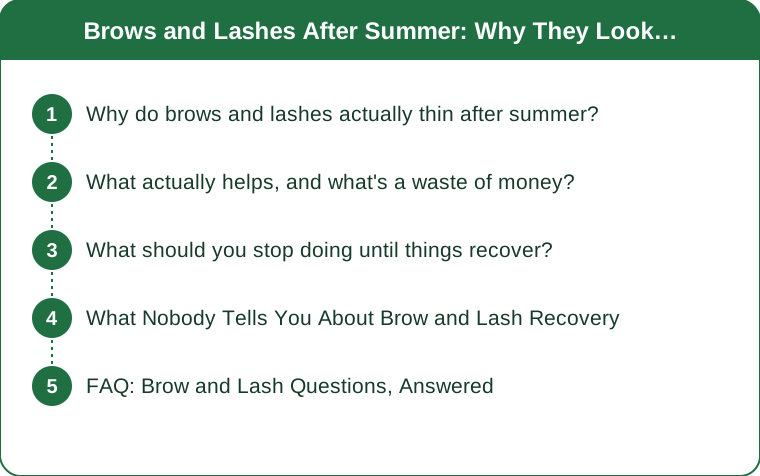
Why do brows and lashes actually thin after summer?
Three separate mechanisms stacking on top of each other.
1. UV damage to the hair shaft. Ultraviolet light degrades keratin and breaks down the melanin that gives hair its colour. The result is hair that’s lighter, drier, and more brittle - so it snaps mid-shaft rather than growing to full length. Brows in particular get sustained direct exposure because of where they sit on the face, and they’re almost never protected.
2. Salt water and chlorine. Both strip the lipid layer from the outside of the hair, which is what keeps moisture in. Chlorine is the harsher of the two and its effect is cumulative across a summer of swimming. Dry, porous hair breaks readily under any mechanical stress - and rubbing your eyes counts.
3. Seasonal shedding. There’s a documented seasonal pattern to hair shedding in humans, with a peak commonly observed in late summer and early autumn. A larger proportion of follicles enter the resting and shedding phase at this time of year, and lashes and brows participate in it alongside scalp hair.
Growth cycles are the reason recovery takes as long as it does. Lashes and brows have much shorter cycles than scalp hair - roughly a few months from growth to shedding for a lash, which is why they never grow long. It’s also good news: a full turnover happens within a few months rather than years.
The practical implication: the thinning you notice in September is largely damage inflicted in June and July. What you do now shows up in November, not next week, and expecting faster results is what drives people from one product to another without giving any of them time.
What actually helps, and what’s a waste of money?
In order of evidence and cost-effectiveness.
Genuinely helps:
Stop the mechanical stress first. This is free and it’s the highest-impact change. No rubbing the eyes, no aggressive makeup removal, no eyelash curler on dry brittle lashes, no lash extensions until things have recovered. Mechanical breakage is doing more damage than any product will repair.
A nourishing oil at night. Castor oil is the traditional choice; there’s limited direct evidence it stimulates growth, and it does condition the hair shaft and reduce breakage, which produces a visible improvement. Coconut oil has better evidence for reducing protein loss from hair. Apply a very small amount with a clean spoolie, avoiding the eye itself.
Peptide-based lash serums. Over-the-counter serums with peptides and panthenol have modest evidence for improving appearance and condition. Expect subtle results over 8-12 weeks, not transformation.
Prostaglandin analogue serums - the prescription-strength category - have genuine clinical evidence for lash growth. They also have real side effects including possible iris pigmentation changes, eyelid darkening, and irritation. That’s a conversation with a doctor, not an impulse purchase.
Adequate protein and iron. Hair is protein, and low iron is a recognised contributor to hair shedding, particularly in menstruating women. Worth testing rather than supplementing blindly - excess iron is harmful.
Probably a waste:
- Biotin supplements if you’re not deficient, which most people aren’t. Deficiency is rare, and supplementation in non-deficient people hasn’t shown benefit. It can also interfere with certain lab tests, which is worth mentioning to a doctor.
- Anything promising results in two weeks. The growth cycle makes that impossible.
- Brow growth serums that are just conditioning oils at ten times the price. Read the ingredients.

What should you stop doing until things recover?
The autumn recovery period is about subtraction more than addition.
Pause tinting for at least six to eight weeks. Tint contains developer that’s harsh on already-compromised hair. The temptation to tint sparse brows to make them look fuller is strong and it’s exactly the wrong move during a shedding phase.
Pause lash extensions and lifts. Extensions add weight and the adhesive and removal both stress the natural lash. Extensions applied to lashes already in the shedding phase come off with the lash, which makes the problem visibly worse and quickly.
Stop over-plucking the gaps. This is the most common and most damaging response. A gap looks worse when you tidy around it, and repeated plucking of the same area can eventually damage the follicle enough that hair doesn’t return.
Ease off waterproof mascara. It requires more vigorous removal, and the removal is where lashes break. Regular mascara removed gently with an oil-based cleanser is much kinder.
Stop using the lash curler on dry lashes, or at all for a few weeks. If you can’t give it up, use it gently and never with mascara already on - curling coated lashes is a reliable way to snap them.
Be gentle with cleansing. Soak an oil-based remover on closed lids for 20 seconds before wiping, rather than rubbing. Rubbing is the single biggest cause of mechanical lash loss and it’s entirely habitual.
What to do in the meantime for appearance: brow pencil or powder to fill gaps costs nothing in follicle health, and a tinted brow gel adds the appearance of density without any chemical process. Fill, don’t fix.
What Nobody Tells You About Brow and Lash Recovery
Five things worth knowing before you spend money.
Brows take considerably longer than lashes to recover. Brow hairs have a longer growth phase, and a brow plucked repeatedly over years may take many months to return - or may not fully. Lashes turn over faster, which is why lash recovery is usually the first thing you notice.
Regrowth looks worse before it looks better. New hairs come in short, fine, and often lighter, and for a few weeks they read as patchy stubble rather than density. A lot of people abandon a working routine at week five precisely because of this stage.
Both change with age, and it’s not the summer’s fault. Growth phases shorten and hairs become finer over time, and brows in particular thin gradually from the tail inward. Seasonal shedding sits on top of that trend rather than causing it, and distinguishing the two saves a lot of unnecessary product-buying.
Thyroid function and iron status are the two medical causes most worth ruling out. Both hypothyroidism and low ferritin cause hair thinning including brows - loss of the outer third of the brow specifically is a classic sign associated with thyroid dysfunction and is worth mentioning to a doctor rather than treating cosmetically.
Consistency matters more than the product. Applying a modest oil every night for three months beats applying an expensive serum sporadically. The growth cycle is the constraint, and nothing shortcuts it - which means the routine you’ll actually do daily is the one that works.
FAQ: Brow and Lash Questions, Answered
How many lashes a day is normal to lose?
A handful is entirely normal, and more during a seasonal shedding phase. What’s worth attention is a noticeable overall reduction in density that persists past about three months, or loss confined to a distinct patch.
Will my brows grow back if I over-plucked them years ago?
Often partially, sometimes fully, and sometimes not - repeated trauma to a follicle over years can permanently reduce its ability to produce hair. Give it six to twelve months of leaving the area completely alone before concluding anything, since brow cycles are slow.
Is castor oil actually proven?
Not for stimulating growth - the direct evidence is thin. It does condition the hair shaft and reduce breakage, and less breakage looks like more growth. That’s a real benefit, just a different mechanism than the claims usually made for it.
Can I use a hair mask on my brows?
Better not to - hair masks aren’t formulated for the eye area and getting them near the eyes risks irritation. A tiny amount of a suitable facial oil does the same job safely.
Should I wear sunscreen on my brows?
On the skin around and beneath them, yes, and most people miss the area entirely. It protects the follicle and the skin, and it’s part of why brows take such a hit over a summer - that patch of face is rarely covered.
TL;DR:
- Three causes stack: UV damage to keratin, salt and chlorine drying the shaft, and seasonal shedding that peaks in late summer
- What you’re seeing in September is damage from June - and what you do now shows in November
- Stop the mechanical stress first: no rubbing, no curler on brittle lashes, no over-plucking the gaps
- Pause tinting and extensions for six to eight weeks; fill with pencil or gel instead
- A conditioning oil nightly beats an expensive serum used sporadically
- Loss of the outer third of the brow, or patchy defined loss, is a medical question rather than a cosmetic one
Most of this recovers within a growth cycle. The main thing standing in the way is the instinct to fix sparse brows by doing more to them.
Keep Reading
This article is for general informational and styling purposes only. Fit, sizing, and product availability may vary.