What to Change in Your Lash and Brow Routine When the Weather Turns
Quick Answer: Expect more visible lash shedding in autumn, adjust to a more emollient brow product as indoor heating dries the skin beneath, and give any lash serum a full 8 to 12 weeks before judging it. Most autumn lash and brow complaints come from three environmental changes - lower humidity, indoor heating, and more frequent eye rubbing from allergies and cold - rather than from a product failing.
If your lash serum seems to have stopped working in October, it is worth checking the calendar before you check the bottle.
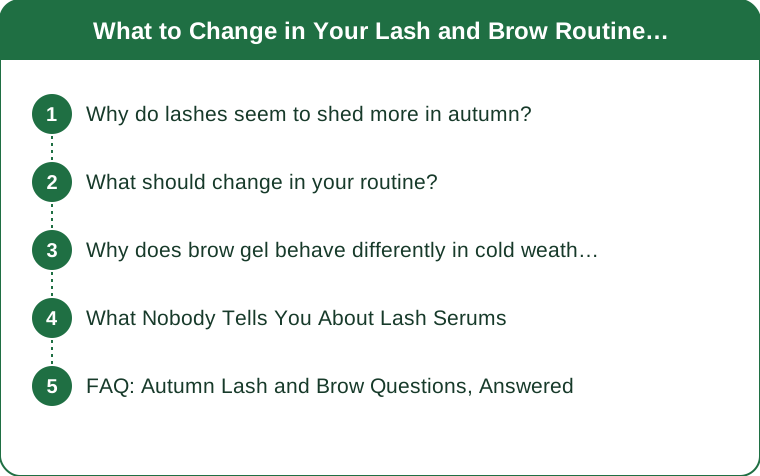
Why do lashes seem to shed more in autumn?
Partly a real shedding pattern, partly the environment, and partly that you are noticing more.
Lashes grow in cycles, like the rest of your hair, with individual lashes at different stages at any time. A full lash cycle is generally estimated at several months, and each lash goes through a growth phase, a transition, and a resting phase before shedding.
Seasonal shedding in hair generally is a reasonably well-observed phenomenon, with many people noticing more scalp hair shedding in autumn. Lashes are frequently reported to follow a similar pattern, though the evidence base here is thinner than for scalp hair.
Three environmental factors compound it:
- Lower humidity and indoor heating dry the skin of the eyelid, and a dry lash line is a more fragile one.
- Allergy season and colds mean more eye rubbing, and mechanical rubbing is one of the most reliable ways to lose lashes.
- More eye makeup and more removal, as the darker season brings heavier makeup for many people. Removal friction is a bigger cause of lash loss than the makeup itself.
What is normal: losing a few lashes a day. What is worth checking: sudden noticeable thinning, patchy loss, redness or crusting along the lash line, or loss affecting brows and scalp at the same time. Those warrant a look from a clinician. This is general information, not medical advice.
What should change in your routine?
Less friction, more moisture, and gentler removal. In that order.
Change the removal method first. This is the single biggest lever. Rubbing is what breaks lashes, and most people remove eye makeup by rubbing.
- Soak a pad in a gentle bi-phase or oil-based remover
- Hold it against the closed eye for 20 to 30 seconds to dissolve the product
- Wipe once, downward and outward, without scrubbing
- Repeat with a fresh pad rather than working harder with the same one
Add moisture to the lid area. A small amount of a bland, fragrance-free moisturiser along the brow bone and the outer lid area - avoiding the lash line itself and the eye - counters the drying effect of heating. Skin around the eye is thin and dries first.
Reduce waterproof mascara frequency. It requires more aggressive removal, and in a drier season that removal costs you more lashes. Save it for occasions rather than every day.
Clean the lash line. A gentle lid cleanser once daily reduces build-up of makeup and oils along the base of the lashes, which supports the health of the follicles. This is the step almost everyone skips.
Ease off heated lash curlers and frequent curling. Heat and mechanical crimping are both harder on a dry lash than a hydrated one.

Why does brow gel behave differently in cold weather?
Because the skin underneath changes, and most brow products are formulated for the skin they were tested on.
In summer, brows sit on skin that is oilier and more hydrated. Products grip well, and the challenge is usually longevity against sweat and oil.
In autumn, indoor heating drops indoor humidity substantially, and the skin beneath the brows dries out. Two things follow:
- Powder and pencil products can look patchy because they are catching on dry, flaky skin rather than blending. The product is fine; the surface is not.
- Gels can flake or lift, particularly the stiffer laminating gels, because the skin underneath is moving and shedding.
What to adjust:
- Exfoliate the brow area gently once a week - a soft cloth or a very gentle chemical exfoliant on the surrounding skin, avoiding the eye - so product has a smooth surface to sit on.
- Moisturise the brow area and let it absorb fully before applying anything.
- Switch from a hard powder to a creamier pencil or a pomade, which sits better on drier skin.
- Brush brows through with a clean spoolie before applying anything, to lift flakes.
On brow lamination specifically: the treatment involves chemical processing, and the drier season is harder on processed hair. Space treatments further apart in winter and use a nourishing brow oil between them, particularly if you are noticing brittleness.
What Nobody Tells You About Lash Serums
They take longer than the packaging implies. Most lash serums require a full growth cycle to show their effect - commonly 8 to 12 weeks, and sometimes longer for full results. Judging one at four weeks is judging it too early, and stopping at that point wastes the money already spent.
They stop working when you stop. Lashes return to their previous state over the following weeks. This is not a flaw or a scam - it is how the products work, and it means the ongoing cost is the actual cost.
Prostaglandin analogue serums have specific documented side effects, which vary by product and include eye irritation, darkening of the eyelid skin, and, in some cases, changes to iris pigmentation. These are worth reading about properly before starting, and worth discussing with a clinician if you have any eye condition or take eye medication. Peptide-based serums have a different and generally milder profile with, correspondingly, more modest results.
Application error is common. Serums go along the upper lash line like a liquid liner, in a thin line, not on the lashes themselves and not on the lower lid. Too much product is the most frequent cause of irritation, and irritation is the most frequent cause of people abandoning a serum that was working.
A serum will not fix damage that is ongoing. If you are rubbing your eyes daily, sleeping in mascara, or removing makeup aggressively, the serum is competing with the cause. Fixing the friction usually does more than the serum does, and costs nothing.
And the seasonal timing catches people out. Starting a serum in September and evaluating it in October means judging it during the period of highest natural shedding. It will look like it is not working when it may simply be swimming against the season.
FAQ: Autumn Lash and Brow Questions, Answered
How many lashes is it normal to lose in a day?
A few per eye per day is generally considered normal, with some variation. Losing several at once when rubbing, or noticeable gaps appearing, is worth paying attention to.
Does castor oil actually grow lashes?
Evidence is weak. It may condition lashes and reduce breakage, which can make them look fuller, but there is little support for it increasing growth. Keep it out of the eye itself.
How often should I replace mascara?
Generally around three months. Older mascara dries out, which means more pulling and crimping at application, and it carries a higher risk of eye irritation.
Can I use lash serum with extensions?
Check with your technician and the serum manufacturer - some serums contain oils that affect adhesive. Many people use serums between sets rather than during.
Why do my brows look sparser in winter?
Usually a combination of drier skin making the area look flatter, seasonal shedding, and less flattering low-angle light. Persistent thinning across brows, lashes, and scalp together is worth having checked.
TL;DR:
- Autumn shedding is partly seasonal and partly environmental - drier skin, more rubbing, more removal
- Change the removal method first: soak for 20 to 30 seconds, wipe once, no scrubbing
- Moisturise and gently exfoliate the brow area so product sits on smooth skin
- Switch powders for creamier pencils or pomades as the skin dries
- Give any lash serum 8 to 12 weeks, and fix the friction before blaming the bottle
Almost every autumn lash and brow complaint traces back to drier skin and more friction rather than to a product that stopped working. Sort the removal routine and the moisture, and most of it resolves without buying anything new.
Keep Reading
This article is for general informational and styling purposes only. Fit, sizing, and product availability may vary.